
Monitor & evaluate impact of Changing Futures
Although it’s hard to measure the impact of the team’s work, it is important that we make every effort to do just this.
Many local government programmes are measures in terms of “numbers of people helped”, “savings to the public purse” and “number of hospital admissions avoided”.
These kinds of measures can apply to Changing Futures work with people facing multiple disadvantage such as numbers of people staying off the streets, public money saved because people accessed the help needed much earlier, or number of health appointments attended rather than avoided… but if we just measure one aspect of the changes made, we will miss out on a wealth of benefits the programme brings. Things like avoiding re-traumatizing people unintentionally through our processes; helping people get the help they need even when they are at their lowest ebb and feeling life is just too chaotic; making sure all the agencies who dela with the five areas of disadvantage know each other and who to go to for advice, in a different team or organisation.
Changing Futures needs a different approach to assessing its impact, so we brought in Cordis Bright to help us get to the bottom of what to measure and how.
Cordis-Bright evaluation framework
 The consultants Cordis Bright have completed a “system impact” framework which they have been developing for Changing Futures. The team is starting to explore applying it to when monitoring, evaluating and evidencing changes in the system around people experiencing multiple disadvantage.
The framework provides flexibility and direction in trying to assess a range of projects within this complex, adaptive systems. Because our system is dynamic, often unpredictable and uncontrollable, and features complex relationships and feedback between the parts of that system, this is no small task!
The framework will help us all to demonstrate positive outcomes where traditional, “number counting” assessments can be unhelpful. For example, knowing how many people you have worked with tells us nothing about the quality of the interaction, how the person being helped felt, or indeed whether the interaction was, itself, re-traumatising.
You can open the report here CFC&P-framework-for-understanding-systems-impact.
The Iceberg model
Once we had the Cordis-Bright framework, we could use this to note down, in a systematic way, the work the team undertakes and how it relates to the four levels on the iceberg.
Cordis-Bright suggested we use the Action Scales Model as this helped categorize the core activities of the team:
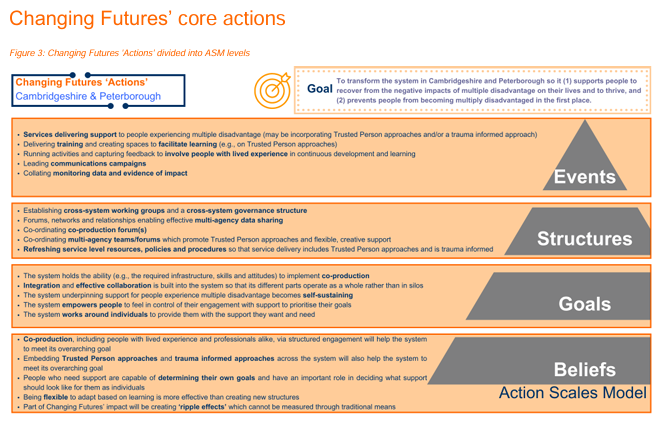
To use the model, we designed our own format based on “the Iceberg” approach to events, structures, goals and beliefs. This helped the team note their actions and categorize them into the four levels. This is what we call our “iceberg”.
Using the iceberg
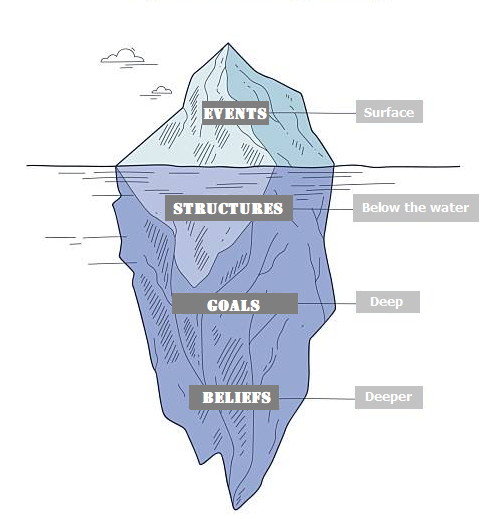
Everyone in the team uses a MIRO page, split into the four levels shown on the iceberg, to note things that they, people in partner organisations, and people who are multiply disadvantaged are doing, or doing differently.
There are separate systems to note progress by individual, how they are helped and who is involved. The Iceberg is to note where the team has caused or witnessed system change on any level, as part of their work.
Some examples
a
b
c
d
Page under construction at 22/05/26